The original design of faith250 has clergy meeting four times, followed by four congregational gatherings. As the earliest clusters formed have reached the congregational gathering phase, we will use this post to share lessons learned.
In the Reston/Herndon cluster, we called our gathering “Fellowship Night” and it was a massive success. We had capacity for 250 people and 170 showed up for a huge potluck at 24 tables with spirited conversation across nine congregations.
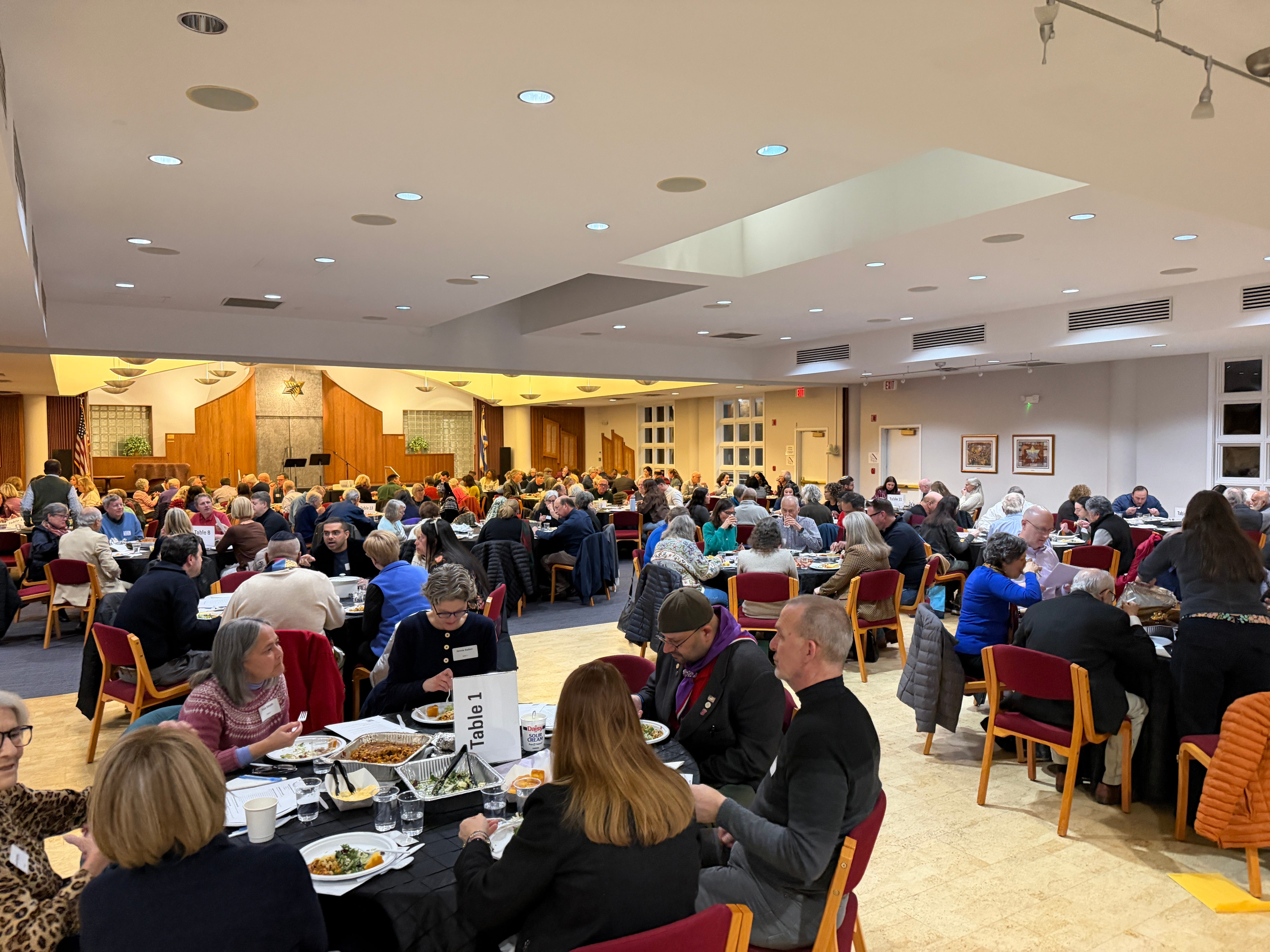
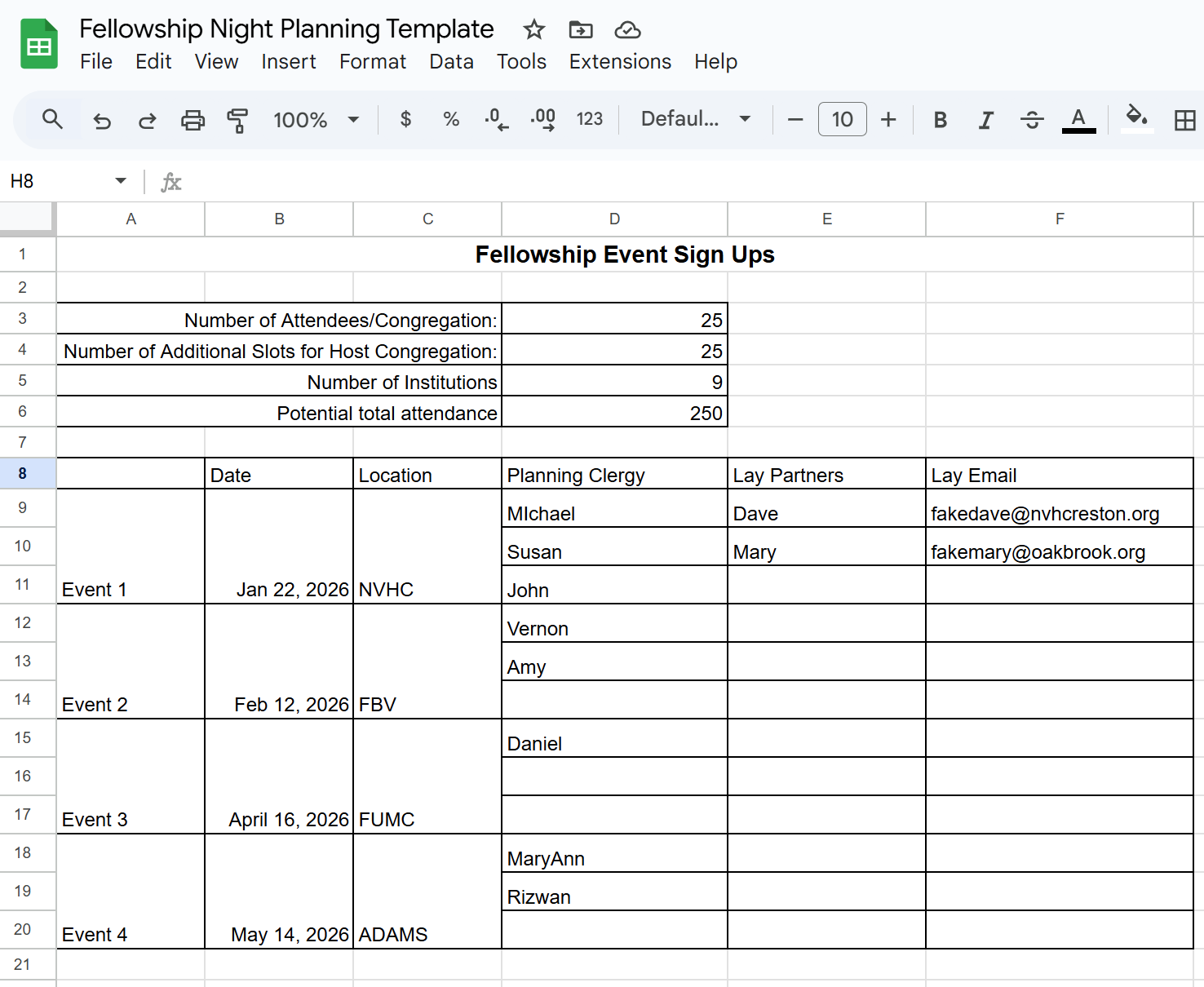
This post will be updated as new ideas emerge, so please share your feedback in the comments section of this post. Each stage of the planning process is recorded in this Google Sheets Template. We encourage you to make a copy of our sheet and adapt it for your needs.
Stage 1: Scheduling and Assigning Leadership Roles
The most urgent priority for all clusters is to set the dates for congregational gatherings and add them to congregational calendars far in advance.
Given that our cluster has nine institutions, we decided to limit attendance to 25 people/congregation, with the host congregation allowed an extra 25 to guarantee enough host volunteers. The congregations with a space big enough for 250 people each signed up for one of the four dates, and a clergy person from a non-hosting congregation signed up as a planning partner.
We also decided to tap a lay person from each congregation to be responsible for logistics and volunteers, and we shared all of that information on our planning template.
Stage 2: Registration and Table Assignments
For our Fellowship Night, the first planning group decided to create table assignments mixed by congregation. This required advance registration which we asked each congregation to do separately and then report to the host lay partner, who organized the registrants into tables of eight people each. We made the mistake of not telling registrants that couples would be split up, and there were about 10 couples with slightly ruffled feathers when they showed up and realized they’d be split. Fortunately, they recovered.
The biggest challenge was getting the registration lists in a timely fashion. Some communities have different norms about registration deadlines, and we just accepted that was part of multi-faith work. It helped when we publicized the deadlines and when the host texted clergy colleagues with reminders to send registrations. We also had hoped to create a teen table, but we were not organized enough in advance, and so we only had four teens, who ended up sitting scattered amongst the adults.
In the end, our lay partners arranged the tables and we created stick-on name tags with table assignments (we chose not to list home institution, so that could be an easy conversation starter). Oh, and don’t forget to make a name tag for all the clergy too. We did and that was awkward! We also left one seat empty at each table for overflow, which was essential because we had unregistered walk-ins from multiple congregations. Lastly, we buffered 15 minutes at the start of the event for seating and identified tables that were half-empty, and then we empowered someone at the greeter table (one of the clergy) to reassign the latecomers and walk-ins.
Stage 2a: Food
Our cluster decided to host a potluck for our first fellowship night. To simplify things we had the host congregation and the planning partner congregation (so two congregations out of nine in our cluster) provide all the food, drinks, and paper goods. We used our micro-grant funding from the Jewish Partnership for Democracy as a reserve to order a few small trays of baked ziti because we were short main dishes (we ended up with lots of extra baked ziti). Our lay partners organized the potluck using Sign-Up Genius, so that is not included in the template, but the rest of our advice is on the Stage 2a tab of the template.
Stage 3: Pre-Read Materials and Set Up
Immediately when we began planning, we realized that the schedule would be very tight that evening. So we decided to create two new handouts: First, we sent all registrants a summary of what to expect and schedule for that evening, which included a pre-session question (called the “Read-Ahead” linked below). Second, we adapted the handout from the clergy meetings for a large congregational group (called the “Handout” linked below).
On the night of the event the organizers showed up 90 minutes early, and our set-up volunteers showed up an hour early. Remember we had two houses of worship (the host and the planning partner) working together. While people were standing around a little, the extra time was a great way to start the multi-faith experience. We encourage you to give instructions to your set-up and greeter teams in advance including, “We will be volunteering with members from X institution. Please, find people from X and introduce yourself.” Volunteers needed a clear set of tasks, so we have a checklist on the template.
Stage 4: Event Schedule
Amazingly, our schedule ran perfectly on time. Miracles happen! The biggest key to that miracle was serving dinner family style, on the table, not by buffet. There were a few ruffled feathers for people who did not like or could not eat what was on their table, and a few tables where two or more people had brought a main dishes and had to sit separately from their own food. A couple of sour faces. So we smiled and had volunteers from the host congregation floating around who spontaneously asked a neighboring table to borrow a dish. We kept the mood light and encouraged people to problem solve with a happy countenance.
Okay, here’s the part you’ve been waiting for… the schedule for Fellowship Night 1: The New Colossus (here in google docs form).
6:00-6:15 p.m. - Arrival
Upon entry, each person received a name tag with table assignment.
At tables, they find copies of the “Read-Ahead” (two per table since these were emailed in advance) and “Handout” (one per person), pens, and Post-It notes.
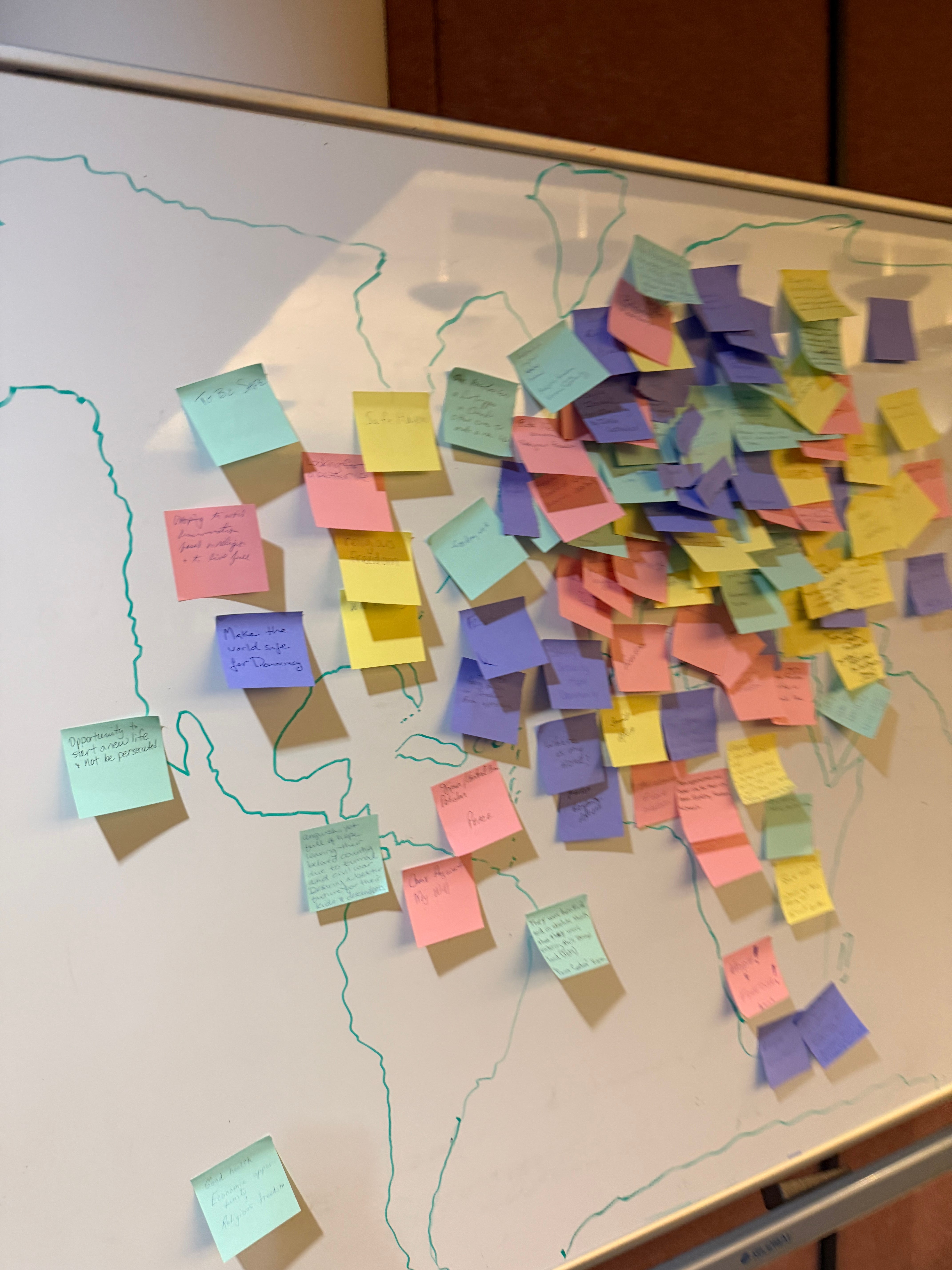
At 6:05 and 6:10 we asked people to write on a Post-It: “What were you or your ancestors thinking or hoping when they came to this country?” And then we had a huge map on the wall for people to place their Post-It on the place from which their family had come (see photo below).
6:15 p.m. - Short Welcome and Opening Blessings
Opening Convocation (2 min): Host clergy 1
Intro to event (2 min): Host clergy 2
Blessing for food (1 min): Clergyperson 3
6:20-6:40 p.m. - Dinner
Talk about the Pre-Session Question: What do you feel when you see the Statue of Liberty?
6:40 p.m. - Intro to Conversation (7 min)
Clergyperson 4 (5 min): Explain the difference between academic vs. spiritual reading and describe various ways of reading text – chevruta, Lectio Divina.
A note about acoustics: because this is a big group, normalize that we do not expect tables to discuss as whole groups of eight.
Clergyperson 5 (1 min): Reading of the Poem - for “The New Colossus”, ideally a woman
Introduction of the Braver Angels magic question (1 min): To be used when faced with a hard difference of opinion: “What experiences happened in your life that brought you to that opinion or belief?”
6:47 p.m. – Self-Guided Discussion at Tables Using the Handout
During this time clergy should be circulating, listening.
Two-three clergy should record notes for sharing out later.
7:25 p.m. – Wrap-Up and Transition to Dessert
Clergypeople 6-8 share a few comments they heard walking around (10 min total).
Instructions for dessert (served at 3-4 tables around the room). Invitation to get your own dessert or get a plate for the table.
Switch seats at the table and meet someone new.
Discuss over dessert: “What can we do as a community to help those coming to our community to find what they’re looking for?”
7:50 p.m. – Conclusion
Grace after meals: Clergyperson 9
Closing remarks: Clergyperson 10
Song: “Give Me Your Tired, Your Poor” + “God Bless America”: Clergyperson 11
Benediction: Clergyperson 12
On the Handout is a QR code with link to a brief feedback form. Please encourage people to fill it out that night. Our faith250 team is happy to share the feedback from your cluster with you.
Keep Us Posted
Good luck on your Fellowship Night planning and please make comments below about how you did things. Share the wisdom. We will update this post as we hear from people. Look for a separate post with testimony from our Fellowship Night.
Here’s what our Post-It world map of aspirations and thoughts looked like: